Size Transitions
Tube size changes in hygienic process routing.
 Dairy ProcessingPasteurizers, CIP systems, transfer lines
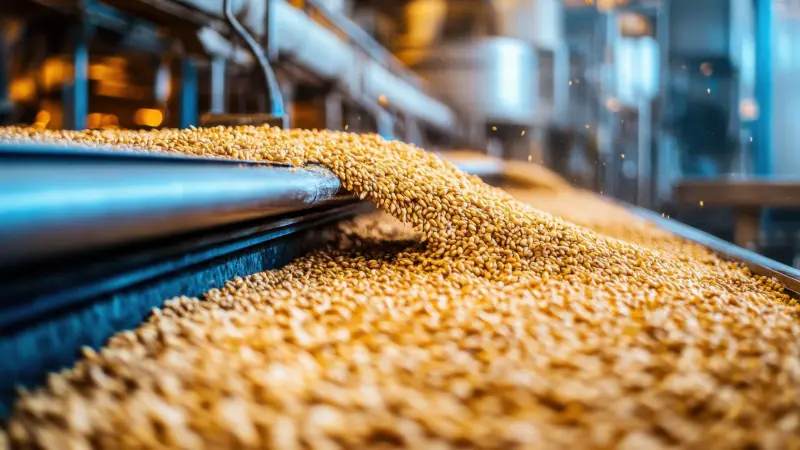 Food ProcessingSanitary fittings, valves and tubing
 Beverage LinesBottling, mixing and hygienic transfer
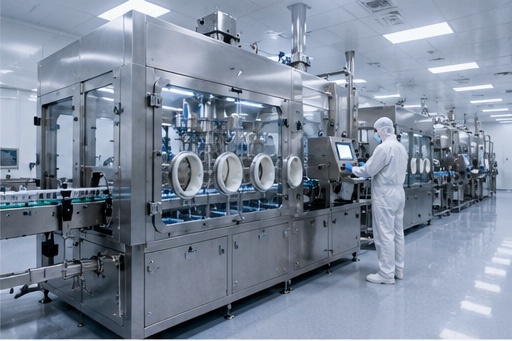 PharmaceuticalHigh-purity 316L and documentation
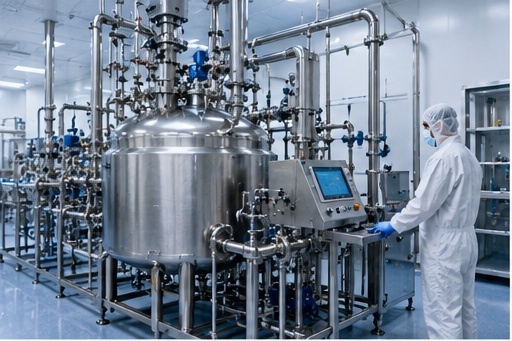 BiotechnologyBioreactors, skids and cell culture support
 OEM / ContractorsProject RFQ support and secondary supply
Sanitary Fittings
Reducers support tube size transitions in sanitary process lines and are specified by size, connection, concentric/eccentric style and material.
Applications
Reducers should be specified by both end sizes and connection types to avoid RFQ ambiguity.
Tube size changes in hygienic process routing.
Reducer packages for skid builders and integrators.
Replacement and retrofit fitting requirements.
Sizes & Dimensions
Concentric (centered) reducers for vertical lines and gradual flow restriction. Eccentric (flat-on-top) for horizontal lines requiring complete drainage.
| Size | Type | OD Large (mm) | OD Small (mm) | Length (mm) | Style |
|---|---|---|---|---|---|
| 2" × 1" | Conc. | 50.8 | 25.4 | 76 | Standard |
| 2" × 1½" | Conc. | 50.8 | 38.1 | 51 | Standard |
| 3" × 1½" | Conc. | 76.2 | 38.1 | 102 | Standard |
| 3" × 2" | Conc. | 76.2 | 50.8 | 102 | Standard |
| 4" × 2" | Conc. | 101.6 | 50.8 | 152 | Standard |
| 4" × 3" | Conc. | 101.6 | 76.2 | 102 | Standard |
| 2" × 1½" | Ecc. | 50.8 | 38.1 | 51 | Flat-top |
| 3" × 2" | Ecc. | 76.2 | 50.8 | 102 | Flat-top |
Operating Conditions
Reducer wall thickness matches the larger tube size. Same pressure rating as standard fittings.
Actual ratings depend on size, material and operating conditions. Confirm via RFQ for project-specific requirements.
Standards & Compliance
Full documentation packages available including MTR, 3.1 certificates, surface roughness reports and pressure test records.
Sanitary fittings standard for hygienic process.
ISO standard for sanitary stainless tubing.
Surface finish, materials and design for pharma/biotech.
Dimensional standard for tri-clamp fittings.
Wrought austenitic SS pipe fittings spec.
EU regulation on food-contact materials.
Food contact materials compliance for seats and seals.
Product Variants
Multiple variants available to match your application requirements. Browse related products for complete process line coverage.
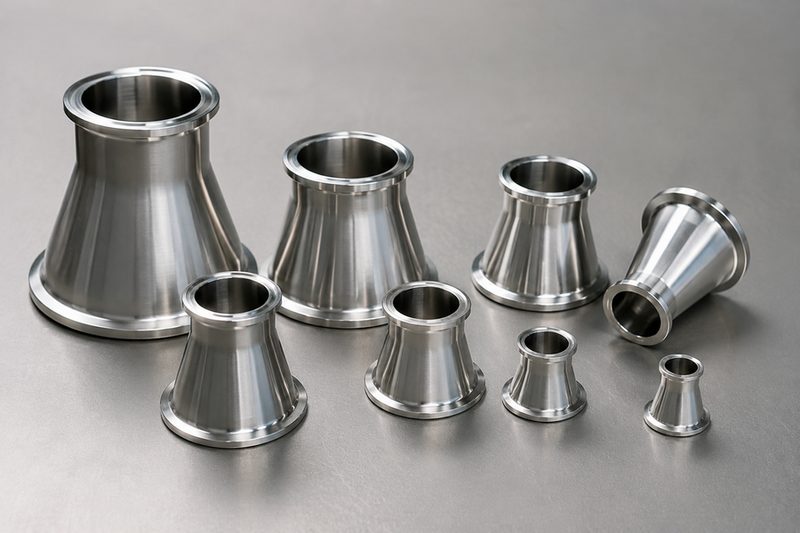
Centered reduction for vertical pipe runs and gradual flow restriction.
Request quote →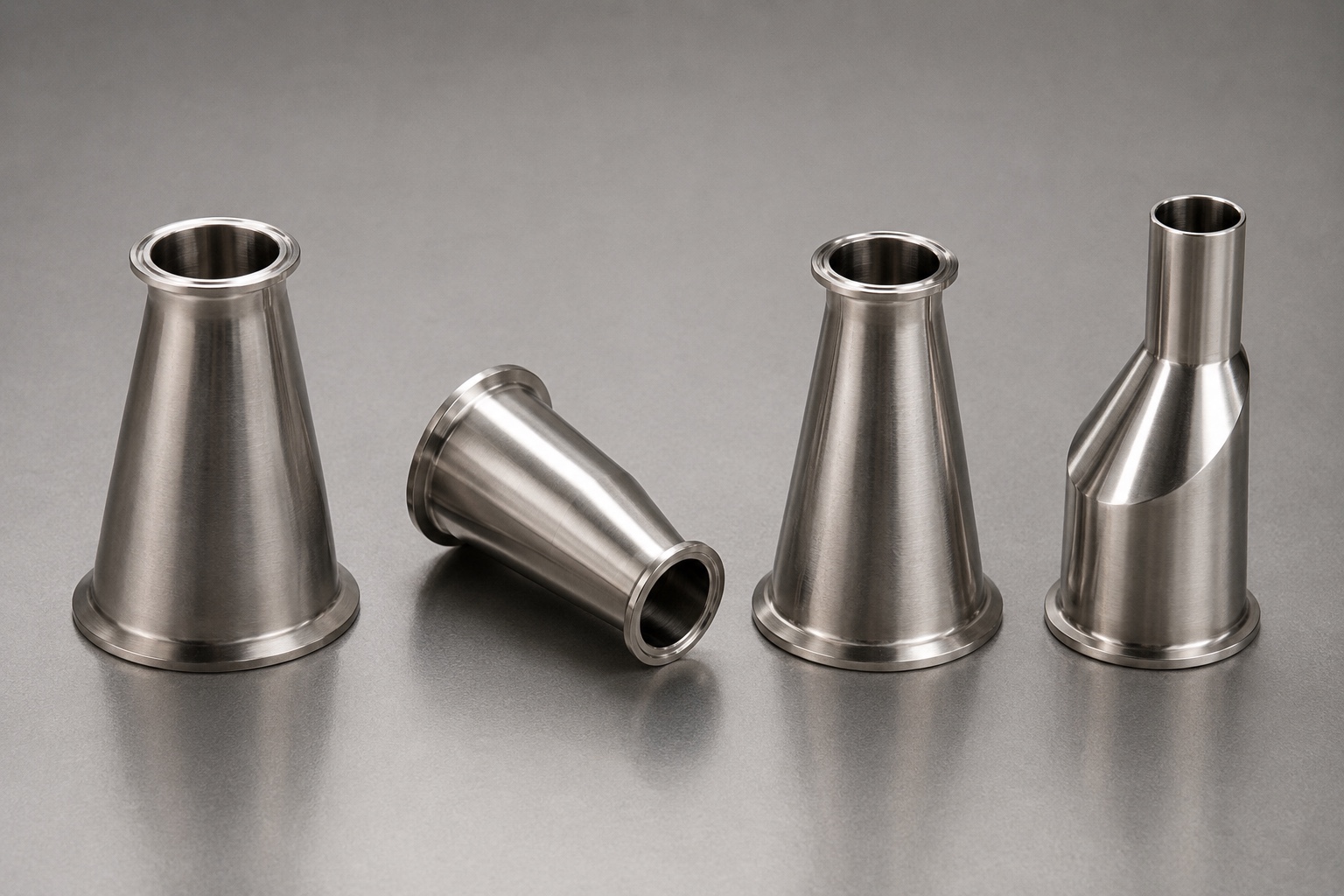
Flat-on-top configuration for horizontal lines requiring complete drainage.
Request quote →
Technical Overview
Specify concentric/eccentric reducer type and connection style clearly.
| Requirement | Typical Information Needed |
|---|---|
| Product Type | Concentric reducer or eccentric reducer |
| Material Grade | 304 / 316L stainless steel |
| Connection | Tri-clamp, weld end or mixed connection by RFQ |
| Size | Large-end size and small-end size |
| Documentation | Material certificates and drawings by RFQ |
Include both end sizes, reducer style, connection types, material and quantity.
Material certificates, finish notes, inspection requirements, heat traceability and supplier documentation can be included in the quotation package.
Send reducer type, both end sizes, connection styles, material and quantity.
Download the product datasheet for technical specifications, dimensional references, material data, applicable standards and RFQ guidance. Suitable for procurement, engineering review and project documentation.
Common Questions
Engineering and procurement questions we hear most often. For project-specific guidance, send your application details via RFQ.
For general sanitary service, Ra ≤ 0.8 μm (32 μin) mill-polished is standard. For pharmaceutical and biotech applications, electropolished (EP) with Ra ≤ 0.38 μm is required per ASME BPE SF4.
For ultra-high-purity (WFI, vaccine production), specify SF5 (Ra ≤ 0.25 μm mirror finish). Surface roughness reports with profilometer measurements available on request.
316L contains 2-3% molybdenum giving superior corrosion resistance, especially against chlorides. For dairy CIP (containing caustic), 316L is highly recommended.
304 is acceptable for utility, water and air applications. For all product-contact surfaces in food, dairy, pharma and biotech, 316L is the standard.
Yes, electropolished (EP) finish is available with Ra ≤ 0.38 μm (SF4) or ≤ 0.25 μm (SF5). Includes passivation per ASTM A967.
EP recommended for pharma/biotech, WFI systems, and aggressive chemical service. Adds ~2-3 weeks lead time. Surface roughness report included.
Standard: EN 10204 3.1 MTR with heat number traceability for all parts.
Optional: surface roughness report, passivation certificate, dimensional inspection, full BPE package for pharmaceutical applications.
Standard configurations in 304/316L typically ship in 1-2 weeks from stock. Custom finishes or specifications: 3-6 weeks.
For project quantities, scheduled deliveries available. Provide target quantity and dates with RFQ for accurate lead time.
Tri-clamp connections use a ferrule on each side with gasket and clamp ring. Weld connections are butt-welded to tubing — orbital welding recommended for hygienic service.
Specify connection type with your RFQ. Weld ends ship with bevels prepared for orbital welding. Mixed configurations (clamp + weld) available.
Yes — all sanitary fittings are designed for CIP (cleaning) and SIP (sterilization) cycles. Smooth internal surfaces and no dead-legs prevent product buildup.
For SIP at 121-135°C, ensure gasket material is rated for temperature (PTFE or silicone). EPDM is suitable for CIP only.