Transfer Lines
Reverse-flow protection in hygienic dairy process systems.
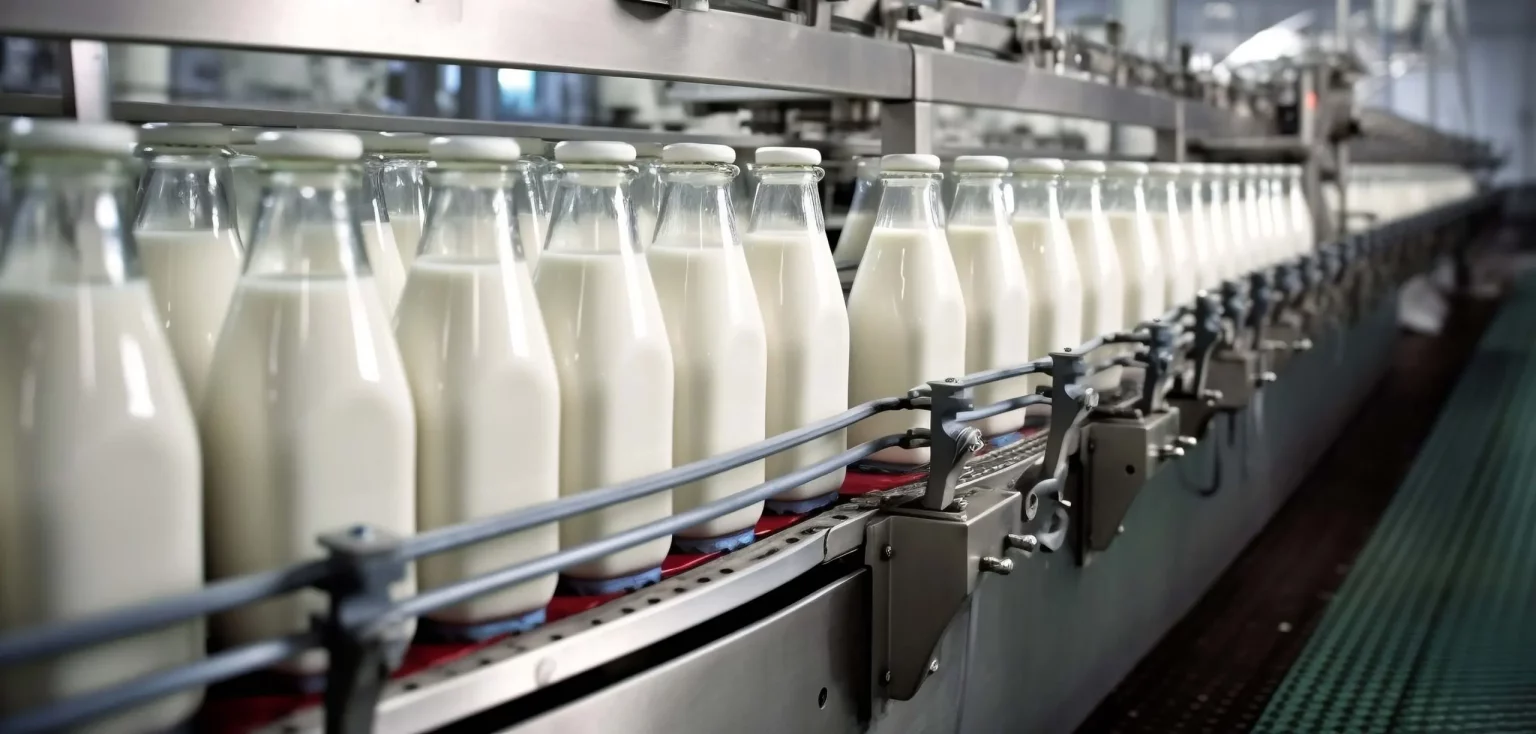 Dairy ProcessingPasteurizers, CIP systems, transfer lines
 Food ProcessingSanitary fittings, valves and tubing
 Beverage LinesBottling, mixing and hygienic transfer
 PharmaceuticalHigh-purity 316L and documentation
 BiotechnologyBioreactors, skids and cell culture support
 OEM / ContractorsProject RFQ support and secondary supply
Sanitary Valve System
Sanitary check valves are specified to help prevent reverse flow in hygienic transfer lines, utility lines and process systems.
Applications
Check valves support hygienic systems where backflow prevention and process reliability are important.
Reverse-flow protection in hygienic dairy process systems.
Commonly requested for transfer and cleaning circuits.
Used in beverage process lines and packaged product facilities.
Sizes & Dimensions
Spring-loaded and gravity-operated designs for vertical and horizontal lines. Tri-clamp ends standard.
| Nominal | DN | OD (mm) | Tri-Clamp (mm) | Cracking Pressure | Cv | Type |
|---|---|---|---|---|---|---|
| ½" | DN15 | 12.7 | 50.5 | 0.07 bar | 6 | Spring |
| ¾" | DN20 | 19.05 | 50.5 | 0.07 bar | 12 | Spring |
| 1" | DN25 | 25.4 | 50.5 | 0.07 bar | 22 | Spring |
| 1½" | DN40 | 38.1 | 64.0 | 0.07 bar | 48 | Spring |
| 2" | DN50 | 50.8 | 77.5 | 0.07 bar | 85 | Spring/Disc |
| 2½" | DN65 | 63.5 | 91.0 | 0.07 bar | 140 | Spring/Disc |
| 3" | DN80 | 76.2 | 91.0 | 0.07 bar | 210 | Disc |
| 4" | DN100 | 101.6 | 119.0 | 0.07 bar | 380 | Disc |
Operating Conditions
Soft-seat materials provide bubble-tight shutoff across temperature range. Spring force determines cracking pressure.
Actual ratings depend on size, material and operating conditions. Confirm via RFQ for project-specific requirements.
Standards & Compliance
Full documentation packages available including MTR, 3.1 certificates, surface roughness reports and pressure test records.
Sanitary equipment for milk and milk products processing.
Surface finish, materials and design for pharma/biotech.
European hygienic engineering and design certification.
Food contact materials compliance for seats and seals.
Material specification for 304/316L bodies.
Dimensional standard for tri-clamp fittings.
EU regulation on food-contact materials.
Product Variants
Multiple variants available to match your application requirements. Browse related products for complete process line coverage.
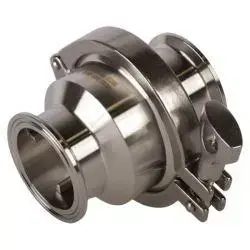
Spring-loaded poppet for any orientation. Bubble-tight shutoff with low cracking pressure.
Request quote →Gravity disc for vertical installations. Ideal for larger sizes and CIP-return lines.
Request quote →Free-floating ball seals on reverse flow. Best for high-viscosity and particulate media.
Request quote →Compact wafer-style fits between tri-clamps for minimal installation space.
Request quote →Materials & Standards
Specify valve style, connection, material grade, spring/seal and documentation requirements.
Common stainless grades for sanitary check valve sourcing.
Connection style should be defined in the RFQ.
Material traceability and inspection requirements by request.
Technical Overview
Cracking pressure and compatibility should be reviewed by supplier for the application.
| Requirement | Typical Information Needed |
|---|---|
| Valve Type | Sanitary stainless steel check valve |
| Material Grade | 304 / 316L stainless steel |
| Connection Type | Tri-clamp or weld end by RFQ |
| Internal Style | Spring, disc or project-specific style by RFQ |
| Service Conditions | Media, flow direction and cleaning method |
| Documentation | MTR/MTC and inspection requirements by RFQ |
Include valve size, connection, material grade, service media, flow direction, quantity and documentation needs.
Use this page to prepare a clear sourcing request for repeat components, project packages, secondary supplier comparisons or plant maintenance requirements.
Common Questions
Engineering and procurement questions we hear most often. For project-specific guidance, send your application details via RFQ.
Install downstream of pumps to prevent backflow during shutdown, at tank outlets to prevent siphoning, and in CIP return lines to prevent contamination.
Allow minimum 5× pipe diameter of straight pipe upstream and 2× downstream for proper flow patterns. Avoid turbulent conditions immediately upstream.
Cracking pressure is the minimum differential pressure required to open the valve. Standard sanitary check valves crack at approximately 0.07 bar (1 psi).
Low cracking pressure means minimal flow restriction. For gravity-fed lines or low-pressure applications, this is critical.
Spring check valves work in any orientation. Gravity disc check valves are typically vertical up-flow only.
For uncertain orientation requirements, specify spring check valves to ensure reliable operation in all positions.
Use spring-loaded check valves which close quickly before reverse flow develops momentum. Soft-seat designs absorb closing energy better than metal seats.
For severe water hammer concerns, install slow-acting (cushioned) check valves or pulse dampeners. Provide pump flow rate and pipe length for evaluation.
Bubble-tight (zero leakage) is the standard for sanitary check valves with elastomer seats. Leak-tight allows minor seepage per API 6D Class V/VI.
For sanitary, dairy and pharmaceutical service, always specify bubble-tight (zero leak) per 3-A standards.
Spring check valves clean well because flow opens the poppet exposing all surfaces. Gravity disc valves may benefit from manual cycle assistance during CIP.
For SIP cycles, ensure cycle pressure exceeds cracking pressure to open the valve and allow steam contact with all internal surfaces.
Standard package: 3.1 MTR for body, FDA compliance for seat elastomer, pressure/leak test certificates. Optional: ASME BPE surface finish reports, ATEX certifications.
For pharmaceutical service, request full BPE documentation. For oxygen service, specify oxygen-cleaned and certified.
Use structured technical information to prepare clearer RFQs, reduce revision cycles and align sourcing requirements before quotation.
Send valve size, connection, flow direction, media, quantity and target delivery needs.
Download the product datasheet for technical specifications, dimensional references, material data, applicable standards and RFQ guidance. Suitable for procurement, engineering review and project documentation.